


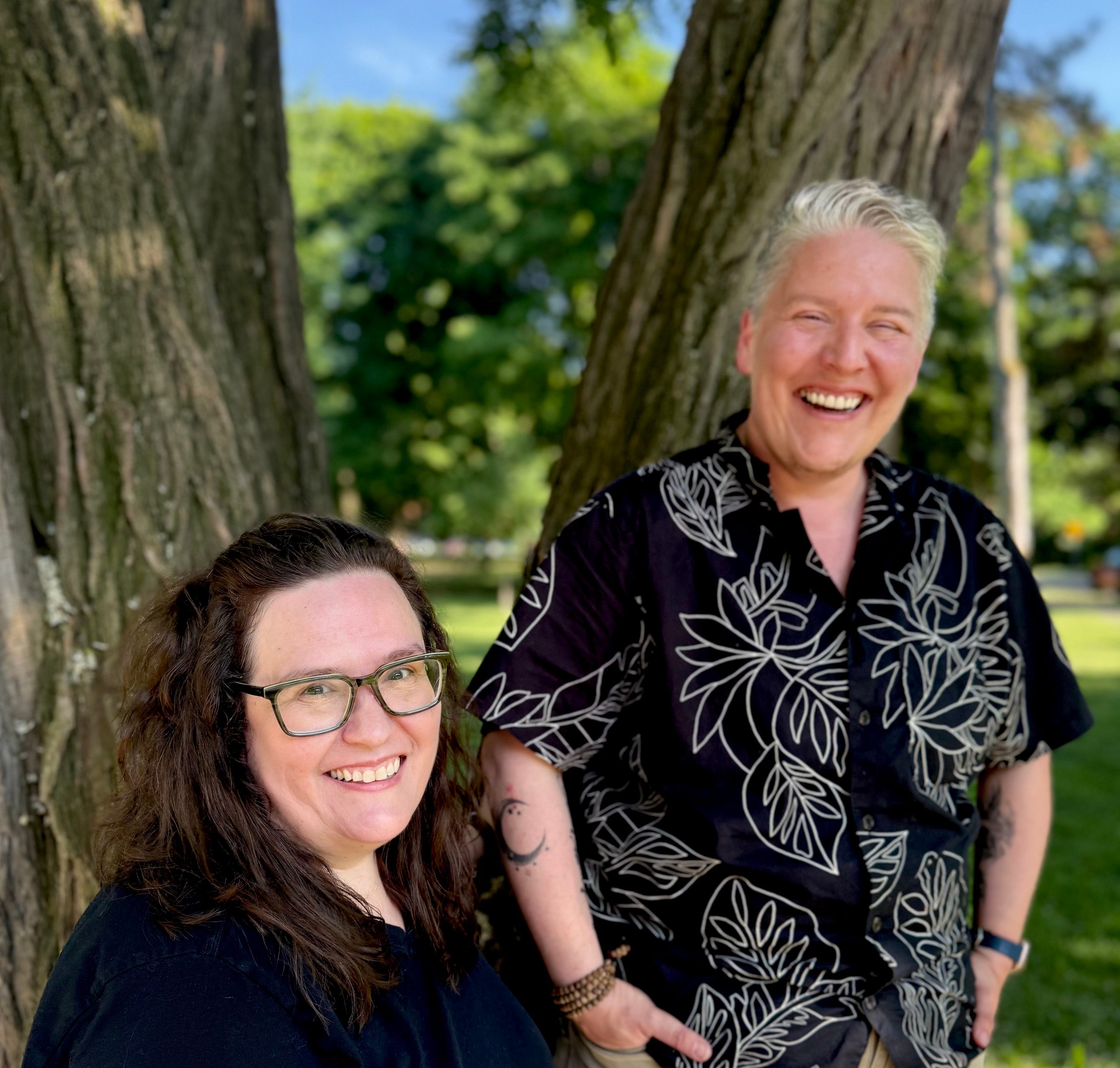
Happy Yew year! We’re kicking it off by sharing a bit more about who we are with you. And what better way than by asking each other questions? Even after years of friendship, we both learned some new things about each other in the process. Ah, the power of curiosity!
In this episode, we talk about our newest projects like Rowan’s café (which opens very soon!) and Lara’s brand new mail club.
We also discuss regrets, hope, taking risks, and even stand-up comedy.
Want to know anything more about us? Comment and we’ll use some of those questions in upcoming episodes.
Look, it’s tough out there. Don’t forget to take some time to rest and experience some joy, ok? Take care of yourselves. ❤️
Links
Rowan’s new coffee shop!
Transcript
[00:00:00] Lara: because you and I. Don’t wish we were in a different place. It’s almost impossible to say I wish I could go back and change it because then I wouldn’t have this thing that I am now, Welcome to the first 2026 episode of Unboxing It. I am Rowan.
And I’m Lara.
[00:00:40] Rowan: We’re thrilled you’re joining us this year. A lot of you joined us last year, our inaugural year, if you will, and this is a brand new year. We’re starting off doing every two weeks. We talked about this during our last episode, and that’s my fault.
If you are hearing this, I have a coffee shop. Now it may not be fully open to the public just yet, so don’t go running over there if you’ve just heard this, but, it is mine now, and I have to do things with it. So it’s going to eat up a little bit of my time and you have stuff going on too, Lara.
[00:01:12] Lara: Yeah, Life gets busy and as we’ve mentioned a few times, this is a passion project for us and there are also needs for making money. So this is going to keep happening, but just a little bit less for a while.
[00:01:26] Rowan: That’s how it goes. That’s how it goes. , One day. I would love to just be able to do things like this ‘ cause I really enjoy this time with you.
[00:01:34] Lara: Me too, me too. A lot.
[00:01:36] Rowan: So, I know you pretty well and you know me pretty well, but there are still some things we don’t know about each other. And one of the things we talked about really early on was, you know, we should do an intro episode. And here we are, episode 36, and finally we were like, I think maybe we should actually get around to doing that.
So we thought. We would interview each other for a little bit. We’ve had other guests on this show and we have interviewed them and had these great conversations, but we thought it might be nice to introduce you to ourselves, to who we are. some of you know us from social media or you know, us personally.
And some of you have found us more recently, either through Substack or through your favorite podcasting app, or through social media to some extent, but you don’t really know us. And obviously we cannot tell our entire life story on a podcast. So first of all, there’s two of us. And secondly, I mean.
Just me alone, I’ve written two memoirs already, so there’s no way, no way we’re covering all that. But there can be some fun little things we can find out by asking the right questions. So that’s what we’re gonna do today.
[00:02:50] Lara: Yeah. They’ll go beyond knowing that we’re both 49, which we have mentioned a few times,
[00:02:56] Rowan: so many times.
Did I mention I’m 49,
[00:02:59] Lara: and that we have a bunch of children.
[00:03:02] Rowan: Yeah. So many children, many children. Yeah. Eight. If you add them all up together, five on my side, three on yours. That’s a lot of kids.
[00:03:10] Lara: A lot of kids.
[00:03:12] Rowan: We could have had a very successful farm a hundred years ago.
[00:03:15] Lara: yes. So you may know a few things about us, you know our opinions on things, but yeah, we thought it would be fun for you to know a little bit more about some of the other parts of who we are. And I think even one of the reasons we thought to do this now was because I mentioned something and Rowan was like, oh yeah, did I know that you did that?
And that was when I was talking about my time living in Asia.
[00:03:38] Rowan: Yeah, I didn’t know about that, , and I was like, how do I not know that? That’s a pretty big thing that you did
[00:03:43] Lara: because it was 25 plus years ago and it doesn’t come up in daily conversation.
That’s true. That’s fair. first of all, just so people who haven’t heard it before, what was your reason for going to Asia and what was your favorite thing about it?
I graduated with a degree in psychology from Carleton University in 1999, and then I didn’t know what to do with myself. That was basically like, what do I do with this degree?
It was a three year degree. I didn’t wanna keep going to school, so I wasn’t sure what was coming next. So that was the reason that I did that. It was kind of like a holding space for me.
What was my favorite thing about living in Asia? So I lived in South Korea and when people ask me if I liked it, I generally say something to the effect of, I learned a lot.
I think my favorite thing, well, I never really had a great desire to go to Asia. It was just the place where they needed English teachers and a lot of them would pay for your flight to get there, so there was no big startup cost, and so that’s why I picked Asia. I will say that ever since.
I came home, it is in my head that I would like to go back to Asia. It was much more than I thought it would be, and I want to explore more of Asia. So that was amazing that I realized that, I was able to explore a new culture. But more than that, I had a lot of things that didn’t go well, and that’s just a long story.
But because things didn’t go well, I learned that I was capable of dealing with things that didn’t go well, and so I came home with a lot more belief in myself.
I came home and thought, I am not meek, which I
did think when I
left.
[00:05:37] Rowan: Wow. So you cultivated a lot of resilience and realized you’re strong as hell.
[00:05:44] Lara: Yeah, because there were some difficult things. I’ll give you one quick example, so I lived by myself, which was not what I was told it was going to be. And I had never thought that I would be good at living by myself like that. I would be okay with that. So first of all. That was something I had to encounter.
But also there was one night I would teach in the evenings till like 10 o’clock at night and I arrived at my apartment and it was down this little alleyway above a restaurant. And when the restaurants would close, they would pull these garage doors down and padlock them. And somebody had closed a garage door and padlocked it over the door to my apartment and,
The school that I worked at, I went back, they were closed. Like, how do you deal with that? And I, figured it out. I had one person that I knew across a city. I figured out how to get myself there by myself in the middle of the night on the subway, and
I was fine.
It wasn’t anything like
earth shattering, but at the same time, when you don’t think you can handle a crisis and you are locked out of your apartment at 10 o’clock at night in a foreign city, in a country where they don’t speak your language and then you figure out what to do, you’re like, ha, I can
do more than I thought.
[00:07:03] Rowan: as you were talking, I was thinking about all the problem solving I had to do as a Gen X kid. I go home, my parents aren’t there because my dad is at his friend’s house, you know, hanging out in his and my mom is maybe out, I don’t know, doing grocery shopping or she’s down the street somewhere and I don’t know where she is.
And it’s like. There’s no cell phones, no internet, nothing. Right? if you can’t track down people by actual phone and they have to be at their house or office or something to receive that call, you are on your own. Do you think your upbringing helped you prepare for that, or do you think that even if you had been more, Sheltered as a child, more so than the average Gen X kid. Do you think you would’ve been able to handle that or would you have had more of a difficult time?
[00:07:55] Lara: So, I actually think I was a little more sheltered than the average Gen X kid. Like my mom had more anxiety than some people, and so I think that I wasn’t left quite to my own devices the way some Gen X kids were.
I think that just in general, I have learned about myself over the years is that I’m pretty good in a crisis. That for all that, I didn’t have a lot of confidence. Every single time that crisis was put in front of me. I. Was more confident than most other times in my life.
And that’s apparently not uncommon in an ADHD neurodivergent brain. Like, you know what? You wanna get the best outta me, put me in the most stressful situation possible, which sucks by the way, that over time, that depletes you. But it’s true that in a crisis type situation, I tend to be a little more stable.
Than other people. And I hadn’t learned that about myself really yet. When I went there, I had experienced it, but I hadn’t noticed the pattern yet, so to speak. And so I had multiple situations like the one I just described in a variety of ways. So I was able to figure out over the course of that year.
I can do some stuff when I need to. I’m capable, I can take care of myself, and that, changed a lot for me.
[00:09:20] Rowan: Well, sometimes you just have to throw yourself, into the deep end, if you will. And sometimes we do that by choice, and sometimes we do that by no choice of our own. It was just, that’s just what happened.
The circumstances of lettuce there, I’ve had more of the. Things happened to me when I was younger.
And I think because of that, because I was thrown into so many wild, unpredictable situations and had to figure my way out of them, it gave me the knowledge like you, that I can handle a lot more than I once thought possible, which has allowed me.
To take much bigger risks now that I’m older. I have completely upended my life in the last three years. So many things have happened, more than I could even talk about here, but I was able to make a lot of choices, of decisions within the upheaval that might not have been on the surface.
The most reasonable decision in the sense that like, things could settle down a lot more quickly if I did it this way. And, you know, a good example of that is, my partner Dani lost her job. Early 2025 and that same week I found out that a big project, I was working on a television project, got shelved because, was a bad time for this type of show politically, and that wasn’t the official reason I was given.
But that’s the reason I’m pretty sure is the actual reason why that happened. I think the thing that most people would’ve done was go, oh wow, okay, so both of us are currently kind of outta work. We should probably go look for new jobs. That should be what we should do. She has 25 plus years in her field.
I have over a decade in mind, you know, yeah, the economy’s not great, but we can probably find things, you know? And I was able to stop and go, okay, but let’s look at the longer term. What does that look like? Is this really what I want to do? Maybe this is an opportunity and being able to look at what can feel like a crisis as an opportunity is growth to me.
So I said, Hey, what if we open up that coffee shop? We were thinking about opening up when we retired. And you know what, now we’re, as I just mentioned, we are just about to open. It’s taken about nine months, but we are getting there and it has been a massive risk depleting life savings, getting the loan from the bank,and just taking risk after risk after risk to get here.
And I’m so calm about it. Overall, I just have this really good feeling and. 20 years ago, me, heck, even like 10 years ago, me, I would not be as centered as I am today doing this, but life has taught me that time after time, every single time. I am faced with a challenge. I come out of it stronger in the end, even if it is really difficult, even if it kicks my ass in the short term, I always come out of it better, and that is how we cultivate resilience, that’s how it’s done and there isn’t a shortcut to it.
Yes, you can do some resilience work in therapy. You can do some self-reflection, some journaling. There’s all these different things that can help, but. Coming out the other side and proving to yourself that you can actually do it, that is what gives you the confidence in my opinion, to know that you can really persevere through anything.
So, yeah, in my own way, I had my South Korean experience, if you will.
[00:13:07] Lara: Right. Plus having a baby at 20 plus, like you had a lot of other things and even earlier than I did that you navigated and successfully got to the other side of.
[00:13:19] Rowan: Yeah, I, haven’t talked about it much on the podcast, but, you know, I was severely bullied in school when I was younger.
I was even set on fire, in middle school. I say high school sometimes, and so I don’t want people to go like, well, you said high school this one time, and you said middle school another time in Quebec. Middle school and high school when I went to school were the same thing. You basically from grade seven to grade 11, you were in high school.
So I was in, the early part of that when I was, set a light by some not very nice girls. And, it really affected me. But I had those things happen. I ended up in a rehab center at 14 years old because I could not stop drinking. I was in really rough shape. I had all these different things.
I lived in shelters when I was 16. And I had a baby at 20, he’s now 29 years old. He’s a really, really cool guy. I was married at 20 and I just went on to have this life that was, I was very precocious in how I lived my life. I owned a home in 1999 when you were, flying to Asia, I was buying a home.
And, feeling like I was playing house. Because I was so much younger than everybody else, so I’ve constantly broken the mold like time and time again. It didn’t use to feel good. ‘ you know, you might hear that and go, wow, must be nice that you owned a home at like, you know, 22 years old and you know.
Yeah, you know what? It was nice that I owned a home in terms of having that security. And also my neighbors would barely speak to me. Because all they saw from what I could see was trash.
And I hate to say that, but that is how we were treated for a really long time. Even though there was no reason other than our age, there was nothing wrong with how we were living.
We really just wanted to exist with our toddler and just, you know, have a nice life, but people were not kind. And so I went through a lot of these. Steps in my life that didn’t feel right because they felt too early. I felt like a fraud. I had massive imposter syndrome. But having done the work about those things and gone to the other side of that, now I’m like, screw it.
I don’t care what people think of me anymore. That’s all that mattered to me. And now it doesn’t matter to me at all, frankly, what anyone says because that line of thinking. Almost was my demise. I almost didn’t make it. I had a massive mental health crisis in 2020 surrounding entirely this idea that people really hated me.
I hate to use the term canceled because that’s so overused, but there was a big thing about. My role in the trans community in 2020 and whether or not I should be writing a book and how successful I was and you know, it was called a grifter and a narcissist and all these really awful things, it really hurt.
and it was also the pandemic. So mental health was not great for a lot of us. I almost wasn’t here anymore. And I came out the other side of that with, well, some diagnoses that certainly helped, some medication that helped and a lot of therapy, a lot of work on myself. And now I’m at the point where I’m like, I just don’t give a shit.
You can think whatever you want of me, it doesn’t matter. I know fundamentally who I am. I know my worth. I know I’m imperfect. So if I make mistakes, I’ll absolutely own up to those things. But I know that I am a valuable member of society and no one will ever take that away from me. So these are the lessons I think that we learn through hardship.
[00:16:58] Lara: Yeah. And I will say, you know, there’s not a shortcut, but there is the ability to do some things intentionally, right? So sometimes we deal with things because they happen to us. Sometimes we can find some of that growth intentionally you know? And obviously these things are nothing the same, but.
I came out more confident by doing some of these things, which was improv and standup comedy. A lot of it was about sort of performing. you know, I’ve done it in a variety of ways, but even doing this podcast, right, like putting yourself out into somewhere where you’re not entirely comfortable and working through it, and every time I do something like that, I come out.
Feeling proud of myself, even if it was hard for part of it and a bit more confident.
[00:17:51] Rowan: Yeah. And again, I think some people would say, I could never do that. I could never do standup. I could never do improv. It’s weird because I have been in front of crowds, I think, more than most people I know, and even. The thought of doing either of those a little intimidating to me still. Right?
Like so I would still hesitate to say yes. I might say yes. I think I could do improv more than standup, even though people have been like, you should do standup. You’re funny. I’m not that funny, by the way.
[00:18:21] Lara: Oh, see, it helped. I thought I was funny already. I just didn’t know if I would be able to do it well in front of a crowd.
[00:18:28] Rowan: Yeah, I can be funny online, but I have time to really like, think about it. I guess that’s true of standup as well. Right? Because it’s not like you’re going out there making up jokes on the spot. You’re coming up with the jokes. My son did standup before he got into music, and he was really funny.
Such a funny kid. He was like 10 years old and he just brought down the whole house. but you know what he said to me afterwards, he got so much attention that America’s Got Talent wanted him. Even though we were Canadian, he got like famous comedians like sharing his videos. I mean, it was amazing.
You know what he said to me though? He is like, yeah, it’s fun, but it’s really stressful. It doesn’t feel good. My anxiety’s too high. And he’s like, I think I wanna focus on something else instead. I was like, that’s amazing. Like a lot of 10 year olds would be like, oh my God, I’m gonna be famous.
This is great. Wow. Right? And he was like, yeah, no, I could be, I think I could be famous doing this. I just dunno if it would feel good, you know, in my head. So I just don’t think I’m gonna do it. And I’m like, wow. Yeah. So now he’s doing music and he’s really good at that too, but., I really appreciated that.
I don’t think I would’ve said no to that at 10. I think I would’ve been like, oh, thank goodness. Now the bullies will leave me alone. ‘cause I’ll, be famous. Like, that’s, that’s where I was at 10.
[00:19:44] Lara: Well, nobody offered me any additional, opportunities after my standup set. However,
[00:19:53] Rowan: you also weren’t 10, so
[00:19:55] Lara: I also wasn’t 10.
But afterwards, a lot of people were like, so are you going to do it again? Are you gonna keep doing standup? And I was like, no, like a check mark. Done. I always wondered if I could do it. I did it. Like, you don’t have to keep doing everything just because you started doing it.
[00:20:13] Rowan: Yeah. You can just try stuff on, if we had started doing this podcast and we were like, okay, we did five episodes, what do you think? Ah, I think I’m done. Yeah, me too. Like that would’ve been fine. Like it would’ve been cool to just try it and see how it worked. And, , that is one thing that I find that I’ve learned as well.
Like, this past year, my relationship of 32 years came to an end and I’ve talked about that online as well. It’s not a secret. and it was, an amicable separation. We were polyamorous towards the end of our relationship, and we both found partners in the last few years that really were just better fits for us at this point.
And some people could see that as a failure. They could really see that as, oh, your relationship fell apart. that’s really sad. I’m sorry you didn’t make it, but I would, at this point in my life, push back on that I wouldn’t have before. I would’ve seen it as a failure. Now I see it as growth.
I think we did something wonderful for each other. I think we gave each other all the love. In the way that it worked for a long time. We had a beautiful family. We raised our children together, and then we grew into different people with different needs, and rather than cling on to a relationship, because that’s the quote unquote right thing to do, we honored where we were and where the other person was.
And we evolved. We evolved into, I wouldn’t even call us friends because friends is too distant. Yes, we’re friends. There’s nothing romantic going on anymore, but we’re family. We’re still family. Like she and her partner are coming over for Christmas, right? Like, we celebrate the kids’ birthdays together.
We send each other funny texts I mean, we’re still friends and that is a success. so yeah, this idea that everything we do has to last forever, the career we choose when we are in school has to be the career that we keep forever. The partner that we meet when we are young and maybe even get married to, and maybe even buy a house with and maybe even have children with, that’s a partner we should be with for the rest of our lives, the way we look, we’ve always.
Presented a certain way, so we should always present that way. The sexuality that we tied ourselves to when we were younger, you know, maybe that doesn’t fit anymore. I mean, all these things can evolve. Our passions, our hobbies, everything. And that’s beautiful. It’s beautiful when we go, that isn’t working for me anymore, I’m gonna let that go.
Because every time we let something like that go from a friendship that just isn’t fitting us anymore, that maybe we have outgrown the behaviors in that friendship to, you know, hobbies that we’ve kept because we really love the friends that we’ve met in that hobby, even though we’re not really interested in it anymore.
Every time we do that, we create space in our lives and time and energy for something that suits us more. Today to come in.
[00:23:14] Lara: I think evolving is the goal, right? I don’t wanna be the same. I think society might have taught us we should be right. Figure out your path, travel the path. But I think that being able to keep learning about yourself, to keep trying new things, to keep figuring out who you are.
And why wouldn’t it change by decade? Like why would we all be the same forever? And maybe that’s a bit of my ADHD talking, but like, how could you possibly just be the same for 50 years, like 80 years? I don’t know. Like it, it makes no sense to me and who I am. Keeps changing. I am a drastically different person now than I was when I went to Korea when I was in high school.
Like all of these versions of me have changed a lot and that’s not a bad thing. I think that’s a great thing.
[00:24:14] Rowan: Is funny you bring up ADHD because before we did this episode, I had written down a few questions for you. Everything from like really innocuous questions to like really deep ones. So get ready.
Should I bring up any of the deep ones? But one of the things I did write was, do you wish you had known about your ADHD sooner? And how would knowing about it sooner have impacted you? Do you think it would all be positive? Do you think there would’ve been some negatives? I’m really curious to know.
[00:24:47] Lara: I think my life would simply have looked very, very different.
So I mentioned that I have a psychology degree. My first plan was to become a therapist. I really liked that idea. I have always been somebody that people talk to. I have always been somebody. Who knows more about people than others like, I am surprised when other people find it surprising when somebody tells them, their whole life story when they first meet.
Because I was like, well, doesn’t that always happen?
[00:25:20] Rowan: Right?
[00:25:21] Lara: So I’ve always been somebody who people talk to and I like helping people. So I wanted to be a therapist, And I didn’t know psychotherapy was a thing back then. I don’t know how much it was around. So I looked into it and I would’ve had to have a PhD.
I’m looking at like another 10 years from where I was at, and school was really hard for me. I could do it. I could get through it. I could get by.
My grades were not great, but they were fine.
But the idea of doing 10 more years of school to get to my career is why I did not pursue becoming a therapist.
If I had known I had ADHD. If I was medicated as a young adult, if I had been given tools, accommodations to figure out how to navigate my ADHD. Then maybe I would have gone through those 10 years and right now be a therapist with a PhD in psychology. I mean, obviously I don’t know, but that’s the biggest thing that I can think of is, if I had known school, would have been easier.
If I had known, I would not have thought, you just can’t do school well. If I had known, I therefore might have done school well and then have taken different paths entirely. I kind of wish I had known, but I also don’t regret the path I took. So it’s hard to, bring those two things together, right?
Like I don’t have regrets,
but also I think it would’ve been nice.
[00:26:56] Rowan: Yeah. I get asked that question sometimes about being trans and only realizing it in my forties, and people say, do you wish you had known sooner? Well, a part of me did know, first of all, I mean, I think a part of me always knew when I look back to when I was a child, I can very clearly outline when things started to get very awkward for me.
It was around the time when girls were sort of expected to. Cover up and be girls and not play with boys and like boys, that was the other thing. I mean, and all these other things, right? But like there were certainly tells very early on, but it’s true that I didn’t figure it all out until I was in my forties.
I don’t want that for most people. I think especially today, should we not take away. All trans youth healthcare, which is happening in some places, including some parts of Canada, and it’s very scary. But even outside of all of that today, there are more options for trans youth than there used to be. So thank goodness.
That being said, I don’t know, I, I don’t live with regret like the way that some trans people do. I think it would’ve been a lot harder to be. An out trans person in the eighties, nineties, early two thousands. I know some people who did it, , you know, they’re still here. But I also know of a lot of people who are no longer here because if you talked to them, they’ll tell you about their friends who didn’t make it.
I also wouldn’t have had my children. And there’s no way in that timeframe like that or that era, rather, that anyone would’ve let me have children any other way probably. So I think my life would look very, very different as well. I am very grateful for the life that I’ve had. I’m especially grateful for my kids, but I’m also grateful for the friends that I’ve made, and a lot of them are women.
I made those friendships as a woman in a way I probably would not have be able to make those friendships had I always presented as a man. So I don’t actually regret. I think this was the natural course that things needed to take in my life. Think I figured out a lot more about myself that actually made my transition a lot easier by the time I got here.
Maybe in some alternate universe there is another Rowan who did it differently and I would be curious to see how he turned out. But I don’t think I turned out that badly. I think I turned out all right and I think I’m happy with where I’ve ended up.
[00:29:28] Lara: I
think it’s such a hard question if you aren’t bitter.
Right. If you’re like, no,
I’m happy where I am. I’m happy with who I am. Do I wish some of it had been easier? Of course. Do I think some of it could have been better or different? Yes. But you can’t disentangle the fact that if you had changed all of that back then, where you would be now would be different.
And I think because you and I. Don’t wish we were in a different place. It’s almost impossible to say I wish I could go back and change it because then I wouldn’t have this thing that I am now, but for other folks for youth now. So you know, I can speak to ADHD and things like that. I’m so grateful my kids, because we have a household of ADHD, have support.
‘ cause I think it’s going to make things easier throughout their lives and I am very happy for that. And we don’t have to worry that saying, that undoes a whole life because it hasn’t happened yet.
[00:30:28] Rowan: Exactly. Yeah. that’s how I feel about trans youth. I’m like, wow, you get to figure yourself out now.
Get the support from educated people. Again, I’m gonna say this does not always happen, but in an ideal situation, this is what’s happening. and then when the time is right, get the medical support that you need so your body doesn’t have to go in a completely different direction. Or if you are gay or bi or pan, or you know whatever it might be.
It is easier to find your people today much easier than it ever has been. And so it’s a beautiful time and I want that for everybody. But my particular path wasn’t that, but it’s not bad. It wasn’t a bad path either. Sometimes I’m afraid to share that because I think that it will be weaponized against.
Trans youth or queer youth in general, where it’s like, well, you waited and you are fine. I’m not fine. I have. Complex PTSD, so I’m not fine. And a lot of that can be brought back to the fact that I had to live in the closet for much of my life and the trauma that that caused me when I was younger especially.
and I do not think that anyone who has to stay closeted is fine. They’re not fine. Find me of someone who’s closeted, who’s really happy that way. No, you won’t find them. And so, no, that’s not what I’m saying. What I’m saying is if it had to be this way, I turned out all right and I got some good stuff out of it.
I could have turned out another way and if society had been ready to have that conversation, I could have had a different life. I think I probably would’ve been okay there too. Right? but I love what I have and I think that’s okay. I think it’s about making peace as well with where you are at.
I don’t think it’s helpful to look back on a life with a bunch of regret and bitterness. I don’t think that helps me. It doesn’t mean that I am. Pushing that down. I’m not, it’s just not there because anything that I did feel in that regard, that little bit of regret, or what if I teased it apart, I examined it, I looked at it and I realized ultimately what ended up happening is what needed to happen for me to be the person I am today.
And because I don’t hate the person I am today.
I’m all right.
[00:32:50] Lara: It’s so much about.
You can’t undo the path that happened,
and so you don’t need to examine it too closely to think about how it could have been better, like we know. A lot of things could have been better. We know a lot of things could have been easier. We know there were things that did not go well. We know all of these things, but I think it’s important to understand that being okay with who you are
now and how you got here doesn’t mean
that you wouldn’t want it different for somebody else, right. It’s just, it’s too difficult to take it apart. Like I said, I think I would have an entirely different life. So how can I say if I wish that had happened unless I was miserable now and I’m not
[00:33:36] Rowan: Exactly. I have other questions.
I won’t be able to get to all of them today, but,
what’s your favorite thing about yourself?
[00:33:44] Lara: I don’t like this question.
[00:33:48] Rowan: I figured you wouldn’t, that’s why I’m asking it.
[00:33:51] Lara: I
think it’s my ability to. Connect with people and care for them and be there for them.
And I get something out of that relationship as well. But I am deeply grateful for the friendships that I have and that I have been able to maintain.
Most of my deep friendships, right? So I have friends and maybe I only talk to them once a year, but I have a friend I’ve been friends with since I was four. I have a friend, I’ve been friends with since I was seven. I have a friend I’ve been friends with since I was 14. Like , I have all these people from over the years, and most of them with a few exceptions.
Once that connection’s made, they’re with me forever, and I, am deeply grateful for that and I do think I will take credit partially, at least, for being able to
have those connections.
[00:34:50] Rowan: Well you are a very easy person to connect with, so I can see why you have so many meaningful connections.
[00:34:58] Lara: Yeah. Thank you.
Thank you. what about you? Can I just throw the question right back at you? What is your favorite thing about yourself?
[00:35:06] Rowan: It’s funny ‘cause I didn’t think about it until you were talking and I was like, uhoh, what if she asked me the same thing? I think my favorite thing about myself is my ability to maintain.
Kindness in a world that is often not kind to me.
And what I mean by that is I’m trans in 2025, 2026. It’s not a good time to be trans right now. there are a lot of cruel people and when you add in that, I’m. A very visible trans person. I’m online. I’m open about being trans. I have a lot of people who follow me.
I’ve written books. I end up getting a lot of hate if I wake up one morning and I don’t check social media right away. But when I check social media, if I do not find at least two or three really hateful comments. That is a very rare day indeed. It is part of my every day to have really horrific things said to me, accusations about what kind of person I am, the most depraved type of person that you can imagine.
All kinds of statements about my mental wellbeing and how delusional I am and how my children should hate me, and I mean so many different things. And that’s just being trans. I’ve, you know, like I said, I was set on fire. I was bullied relentlessly. I’ve had exes, not my ex-wife, but before her, I’ve had exes treat me very terribly.
I have maintained this level of optimism and resilience and empathy. I’ve maintained a lot of empathy and I help people all the time. I don’t talk about it, but I’m always behind the scenes helping someone in whatever way that I can, if we are ever judged, and that’s not why I do it. I’m not religious, but if it should come to pass that we are judged by our actions, I think overall I’m gonna be okay.
I’m gonna go to a really nice place. So, and that’s not to pat myself on the back, that’s just, you know, for a long time all I could focus on were the things that I got wrong. But there are so many things that get right, and one of them is that I refuse to let anyone take my humanity away from me because my humanity is what allows me to treat others better.
So I’m really proud of myself for that.
[00:37:44] Lara: Yeah, that’s amazing. And your humanity is what has helped you connect to so many people who wanted your stories and your message. And I know some. Probably publicly thank you, but not as many as publicly say mean things to you. And we all know that the mean ones are the ones that are easier to take to heart whether or not that is how we want it.
But you have done amazing things and so I am also grateful for that when it comes to you. How about we do something a little lighter? Now, can I ask you.
Why did you wanna open a coffee shop?
[00:38:23] Rowan: Well, there are a lot of comments online about how I’m not mentally well, and this might be the proof of it.
[00:38:29] Lara: Okay.
[00:38:30] Rowan: No, you know what? The reason I wanna open a coffee shop is because I’m really big on creating safe places for people. That is again, has a lot to do with how I grew up and how I was treated, and the world we live in today.
I think that we got, and you wanted it to be lighter and it is gonna be light. I promise it’s gonna be light, but I have to, you ask the question, I have to answer it properly. We were getting to a real sweet spot in Canada anyway with L-G-B-T-Q rights and, you know, same sex marriage was legalized, trans rights were enshrined, into human rights.
And, you know, things were doing really, really well. And then we started to see a backslide. We saw it in the us, we saw it in the uk. It started to happen here. What I’m trying to get at is that for a while we all kind of were like, it’s all right. We can just kind of, well, I don’t wanna say we all, some people never felt safe, and especially if there’s intersectionalities like race or disability, there are a lot of reasons why people didn’t feel safe anyway.
But for a lot of people I’ve talked to. And myself included, it started to feel safer to just go out into the world and just live your life and you just happen to be queer. that’s it. You just happen to be queer. Nobody cares. It’s fine. And then everything started to push back. So we started to get scared again, much more scared.
And you have everything happening from like corporations pulling out a pride to anti-discrimination laws being pulled and now people are losing their jobs. I mean, all these different things started happening all over the place and we’re realizing that community. in person community is more important than ever.
Being around your people doesn’t just mean, for example, queer people, just being around queer people, but being around people that you can feel safe with and you can be yourself with is the most important thing. So I’ve always been a community builder. From my talks to my books, to everything I do, my online presence and just in my day-to-day life, I love to, meet a really cool person.
They become a friend. and I realized, oh, I want to introduce them to this friend because they’re gonna get along and like, I’m always building these communities. And I thought, why not do that every day in a coffee shop? Because coffee shops for me, especially when I was. Broke, and living on my own.
When I was 16, 17 years old, I could afford a coffee. I couldn’t afford much else, but I could afford a coffee. So being able to create an affordable, quieter, safer third space for people. And we purposely put it in the heart of Toronto’s gay village because. It’s just a great place for it. It’s accessible, it’s easy to get to, and it brings people back to the heart of the community.
Then it’s open to everybody who wants to be there in this safe community. So it’s not just about serving coffee. I love coffee and I love wine. We’re gonna be serving that too. I love those things, but they’re just. Part of what we’re doing. It’s a community space. It’s a place to be home, to come in and go, I feel good here.
And that’s all I ever wanted. I’ve always wanted it. So you know what, I’m just fucking creating it. I’m just doing it. Here we are. We’re doing it now.
[00:42:03] Lara: That’s fantastic. I think the affordable aspect is a big one. Because, yeah, a cup of coffee is a lot more affordable than a lot of things. As, as you were talking, I was like, if I was gonna do it, I would do like an art studio and we certainly wouldn’t be open early in the morning or late at night.
But I also have less energy than you.
[00:42:26] Rowan: That’s the other thing. I’m full of energy, right? I’ve, got tons of energy. I know eventually I won’t. But right now I do. I always have. I got it from my mom. My mom putters around. she has multiple disabilities now, but even with all of that going on, my mom can still get going.
She amazes me. And so I have that. Why not use it? Why not use it to do something? At the end of the day, I’m also a really spiritual person, not religious, but spiritual and I believe that part of why I’m here is to leave the world a little better than when I came into it. And I can’t stop all the terrible things from happening, you know, but I can.
Create some kind of small counterbalance to that, and if we all created some kind of small counterbalance to that, well, that just becomes its own form of revolution, doesn’t it? Am I calling for a revolution on a podcast? No, I can’t say yes. I’m gonna say no, but I am saying the world has to rejig itself because it’s not right, right now.
So the more that we can do in this direction, the more it helps everybody.
[00:43:34] Lara: And I’m grateful that there are people like you who do have the energy to open a space like this. I often dream of having an art studio or a third space of some kind, but I don’t. See myself having the capacity for it. So instead I do things like start a mail club where I’m going to hopefully bring people a little bit of joy in their mailbox once a month instead of opening a coffee shop.
But I think to your point, you know, we all have little ways that we can create connection, remind people to be kind and change the way people think. while not all of them are the same, I don’t know, size, there are lots of different ways that things like that can be important and can help people.
[00:44:17] Rowan: Exactly. All right. We have gone on for a good while. We should wrap this up with maybe one more question, so I have a question for you. You can either throw it to me or you can just come up with a different one. But. question for you, and this is this, I’m sorry this is overused as an interview question, but I think it’s pertinent to what we’re talking about here.
If you could go back and
say something like one thing to your younger self, what would it be?
[00:44:38] Lara: I definitely have thought of
this question before and tried to figure out an answer, and I think. One of the roadblocks that I get when I think about it is I could tell her, but she wouldn’t believe me,
it’s to believe in the power that you have to believe that you are capable of a lot to believe that you are going to be able to do great things because that younger version, you go back to me at 15 or 16, I was afraid of my own shadow. I didn’t want anybody to notice I existed.
And clearly I’ve come a long way, which I think is a good testament to the fact that change can happen. And I think of that young version of me and I’m like, she wouldn’t believe it if I told her. She’d be like, no, that is impossible. But I would still want her to hear that
everything isn’t always gonna feel as scary as it does now.
You are
a capable person
who can do really great things.
[00:45:43] Rowan: Yeah. it’s almost like if you went back and said that
it might take away some of the magic of the journey too. because if you knew that already. Maybe it would’ve given you more confidence, but you wouldn’t have learned what you’ve learned through hardship, if you will.
[00:46:02] Lara: I think it goes back to the same thing we were talking about before where it’s not that we don’t think certain things would be great if they happened to us when we were young, but I don’t wanna take away who I am now. And so there’s a little bit of conflict in thinking you could change everything for younger you when that means you wouldn’t be who you are
now.
[00:46:22] Rowan: Hmm. Straight into philosophy. I love it
[00:46:25] Lara: Straight into philosophy. I have said this many times, I’ve like, I would love to just sit around and talk and have ideas all day long and that would be my job. Philosopher,
[00:46:37] Rowan: we just need a few more subscribers.
[00:46:40] Lara: Just a few more.
[00:46:42] Rowan: Just a few more, just enough to pay a living wage to both of us.
And then, you know, I can just leave the coffee shop in capable hands and we can just do this all day.
[00:46:52] Lara: Maybe one day, maybe one day. And until then we have the podcast that we’ll do every other week. We’ve already written books with all kinds of our ideas and thoughts that people can, learn from and.
I hope that people might have learned a little bit more about us today. We certainly, I realize, could do this for multi episodes ‘cause we haven’t talked about coaching or the work that we do in other areas. There’s a lot that we could keep talking about, but maybe you know us a little bit better than you did before and that will just help you feel connected to us as you keep listening to the podcast.
[00:47:29] Rowan: Oh, I like how you brought that back. If you have some ideas for us, you have questions that you wish we had asked each other, that we had thought about we absolutely could do more episodes like this. we just like to keep the focus on. Society in general most of the time with some personal story wrapped into it, of course, because that is the best way of getting messages across.
Most of the time, storytelling actually helps people retain information much better. indigenous cultures have been doing it for a very long time, and in my. Culture, which is Ojibwe. storytelling is a big factor. So I love that I get to do a little bit of it, and I love the opportunity to share a little bit of ourselves with you, but really.
You were like, oh, I really wish you two had gotten to this about yourselves. Let us know. ‘cause we when I’m good and burnt out from this coffee shop, answering a few questions about myself will feel, I think like a challenge, but not too much of a challenge, and that would be great.
[00:48:42] Lara: Yeah, and we’ll link to the stuff we talked about . If you’re in Toronto area, you can go check out Rowan’s third space that’s opening soon. and I will link to some of my stuff. If you wanna find out more about me and what I’m up to.
Like my mail
club.
[00:48:55] Rowan: Mail club. Mail club. Yes. I love your mail club.
Everybody needs to know about it. So yes, go check out Lara’s Mail Club. You want a little bit of joy every month.
[00:49:04] Lara: M-A-I-L.
[00:49:06] Rowan: Yeah, yeah, yeah. Not M-A-L-E. If I started one, I’d be the. male. The Mail Club, you know, like
Muscle Flex,
[00:49:17] Lara: M-A-I-L, and it’s a little bit of joy in people’s mailbox.
Yeah. MAIL box. Yeah. Yeah, I can, I’m not gonna make a joke about that. as a trans man, I could, but I’m not going to. Anyway, thank you so much for joining us today. We love that you join us and, we will be every two weeks for the next little while, but as Lara has said previously, it gives you time to go listen to or maybe re-listen to some of our old podcasts.
There’s 35 of them before this one. Take care, everybody. Take care
everyone. Have a great day.


